Summer Series- Don’t be Stupid: Part 2
Natural sun protection information.
In my last post we looked at the dangers of over exposure to UV light and the potential health risks of certain sunscreen ingredients. Today we are looking at natural oils and plant based products that can be incorporated into your summer skincare along with practical tips on protecting your skin.
There is so much research about different oils and their possible SPF content. In this article, which can be found here: https://pmc.ncbi.nlm.nih.gov/articles/PMC3140123/#sec1-4, we can look at this chart which shows the SPF content of carrier oils along with a few herbal oils. Let’s take a look.
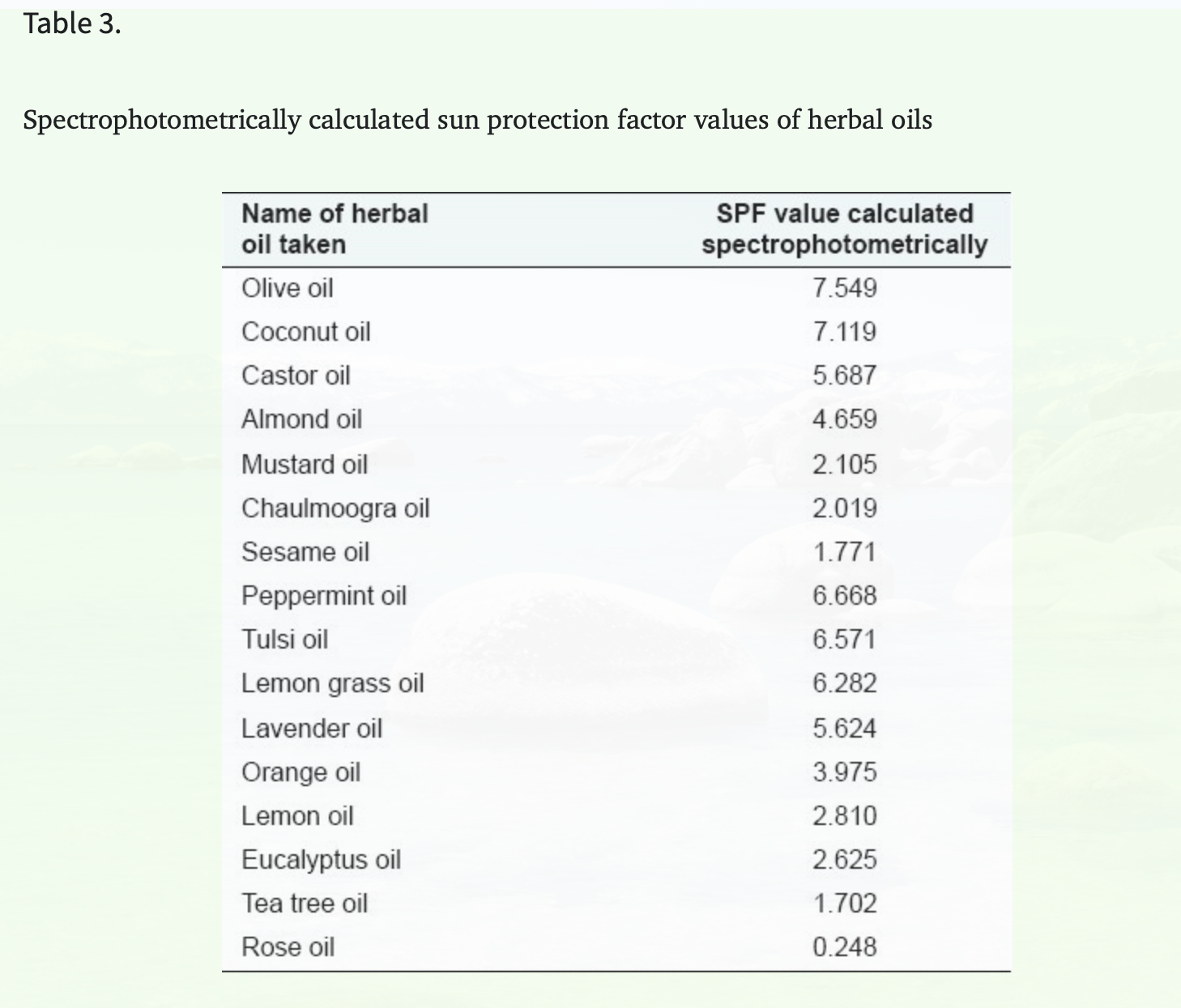
We can see that we can get some protection, not much from these oils. Now we can dive into some specific oils not mentioned in this chart.
Using natural oils for natural sun protection has many benefits, especially when using them in combination with specific essential oils. Sadly, there is no commercial impetus to clinically test carrier oils for their SPF values, so I don’t make any claims related to that aspect of this. I will however highlight the oils used and my reasoning for including them in my summer sun oil.
One of the most versatile sun protective carrier oils, Raspberry Seed Oil. There are several scientific studies recognizing the sun protective benefits of Raspberry Seed Oil. “Raspberry Seed Oil provided average UV protection by absorbing the harmful UV-rays and ensured consumer safety and avoidance of harmful organic UV filters with potential toxic effects.” https://skin.dermsquared.com/skin/article/view/2939/2213
Organic Broccoli Seed Oil is considered antioxidant, anti-aging, antifungal, sun-protective, anti-allergic, wound-healing and anti-inflammatory. “Sulforaphane mobilizes cellular defenses that protect skin against damage by UV radiation".” https://pubmed.ncbi.nlm.nih.gov/17956979/
Buriti Oil is reported to have the highest beta-carotene content of all carrier oils, it is excellent for signs of aging and inflammatory skin conditions, such as acne, eczema, rosacea and psoriasis. Organic Buriti Oil is considered antioxidant and photo protective. “The oil extracted from the buriti pulp is utilized by the cosmetics industry for products such as sun creams and creams for treating burns and preventing early skin aging due to its cicatrizing and antiaging action, which is attributed to the antioxidants (carotenoids and tocopherols) that act by eliminating free radicals.” https://pmc.ncbi.nlm.nih.gov/articles/PMC9229003/
Pomegranate Seed Oil is reputed to possess an unofficial SPF of 8. This oil is thought to stimulate keratinocytes, which are the cells found in the outer layer of the skin as well as being rich in antioxidants. “pomegranate seed oil show to inhibit markers for UVB-induced skin damage…Recently, pomegranate (Punica granatum) extracts have gained significant attention because of their beneficial effects, including anti-inflammatory, anticancer, and antimicrobial activity. In addition, in vitro studies on cell cultures of normal human epidermal keratinocytes highlighted the protective effects of pomegranate fruit extract against UV-A and UV-B radiation.” https://www.researchgate.net/publication/332280336_Use_of_Vegetable_Oils_to_Improve_the_Sun_Protection_Factor_of_Sunscreen_Formulations
Tamanu Oil is one of the few oils to be verified as sun protective, with a specific SPF value, in clinical scientific literature. A Pub med article attributes an SPF value of 11.2 to this Oil. https://pubmed.ncbi.nlm.nih.gov/33721242/According to this article, the sun protective benefits of Organic Tamanu Oil are likely due to the high proportion of calophyllolides found in this oil. Another study corroborates this claim, but states the the SPF value for Tamanu Oil is between 18 – 22. https://pubmed.ncbi.nlm.nih.gov/17188472/
Now let’s consider some other smart ways to stay protected. We covered some of these on the first post, but it never hurts to review.
Cover up. These best protection is covering your skin with lightweight clothing and a hat.
Avoid the middle of the day hours in which the sun is at its highest point. This also saves you from the hottest part of the day!
Get modest sunlight in chunks everyday of the year. When our body is used to being in the sun, this helps our skin in the long run. This doesn’t mean tanning everyday, just being outside on a walk, in the garden or having a meal.
Find a safe sunscreen and wear it.
If you don’t know where to start to find a well researched, natural product. You can start in our store under the skincare page. We have a summer line that incorporates nature’s natural protectors.

Summer Series- Don’t be Stupid: Part 1
Let’s look at the facts on skincare and the sun. Do we need protection? Is sunscreen harmful? Is skin cancer the suns fault? Walk with me as we take a holistic look at one of the summer’s major debates.
There is so much conflicting information on the sun and its impact on the skin. I get questions like, “It is the sun’s fault that we get skin cancer OR did our sunscreen cause it”? I also hear statements like this one, “I am wearing tallow, so I am safe from sunburns.”
I am going to unpack the debate about sun and our skin in this post.
It’s always a good idea to start with some facts. Let’s look at the most recent facts about skin cancer from The Skin cancer Foundation.
1 in 5 Americans will develop skin cancer by the age of 70.
Having 5 or more sunburns doubles your risk for melanoma.
In the U.S., more than 9,500 people are diagnosed with skin cancer every day.
More people are diagnosed with skin cancer each year in the U.S. than all other cancers combined.
The diagnosis and treatment of nonmelanoma skin cancers in the U.S. increased by 77 percent between 1994 and 2014.
About 90 percent of nonmelanoma skin cancers are associated with exposure to ultraviolet (UV) radiation from the sun.
One study found that regular daily use of an SPF 15 or higher sunscreen reduces the risk of developing squamous cell carcinoma by about 40 percent when used as directed.
Regular daily use of an SPF 15 or higher sunscreen reduces the risk of developing melanoma by 50 percent.
The vast majority of melanomas are caused by the sun. In fact, one UK study found that about 86 percent of melanomas can be attributed to exposure to ultraviolet (UV) radiation from the sun.
Indoor tanning devices can emit UV radiation in amounts 10 to 15 times higher than the sun at its peak intensity.
An estimated 80 percent of visible skin aging in Caucasian women is caused by the sun.
People who use sunscreen with an SPF of 15 or higher daily show 24 percent less skin aging than those who do not use sunscreen daily.
I think it is safe to say that people who use tanning beds are at a higher risk for skin cancers than those outside. We can also conclude that sunburns should be avoided to lower our risk of developing possible skin cancers. So now let’s talk about simple ways to lower our risk (other than not tanning in a tanning bed).
Seek the shade, between 10 AM and 4 PM when the sun is at its peak. This is especially true for the beach or pool.
Don’t get sunburned.
Avoid tanning, and never use UV tanning beds.
Cover up with light clothing, including a broad-brimmed hat and UV-blocking sunglasses.
Use a sunscreen with an SPF of 30 or higher every day if you are in the sun.
Keep newborns out of the sun.
Examine your skin head-to-toe every month.
See a dermatologist if you suspect any changes on your skin or if you are more at risk for skin cancers.
Now before you shoot me because I listed sunscreen. Let’s look at some facts about sunscreen and actually look at some facts so that we aren’t basing our information on hearsay.
The Food and Drug Administration is responsible for determining the safety of products that we use and they don’t have the best track record of making great decisions. The FDA has reviewed sunscreen ingredients and has repeatedly stated that out of 16 ingredients it reviewed, only two – zinc oxide and titanium dioxide – are “generally recognized as safe and effective,” or GRASE. (https://www.federalregister.gov/documents/2019/02/26/2019-03019/sunscreen-drug-products-for-over-the-counter-human-use)
The European Commission Scientific Committee on Consumer Safety published final opinions on the safety of three non-mineral ultraviolet, or UV, filters and determined them to be a problem to human health. There is mounting evidence that some of these ingredients causes disruption to our hormones. Studies have found these chemicals in breast milk, blood, urine and even residue still on the skin weeks after their use.
So, let’s go back to the 2 safe ingredients: zinc oxide and titanium dioxide. I have heard some rustling of feathers on these two as well which means we need to look at the facts on them specifically. These two aren’t considered to be absorbable through the skin. If you have ever used a mineral sunscreen with zinc, you know what I mean (ghost face anybody?)! There also isn’t much concern with their endocrine disruption potential. There is concern over inhalation from spray sunscreens using these ingredients and spray products, in my opinion, should be avoided until we know more.
Mineral sunscreens sometimes contain an ingredient called butyloctyl salicylate, or BOS. I would screen for this ingredient because studies from the EU that show harm to reproduction and the developing fetus. For this reason, salicylic acid and several other salicylates cannot be used in kids’ products in the EU. So to be on the safe side, I would avoid sunscreens using this product.
Do we have a solution? We don’t want to burn, but don’t have a great selection on natural products to use. On the other hand, we know sun is required for vitamin synthesis, circadian rhythm and overall wellness.
Stay tuned for part 2, where we will dive into this topic even more.
https://www.skincancer.org/skin-cancer-information/skin-cancer-facts/
https://www.ewg.org/sunscreen/report/the-trouble-with-sunscreen-chemicals/